What Is NeuroAnalytics? And Why It Matters in the Age of Data Overload
We’re living in a time where data is everywhere, clicks, scrolls, likes, views, survey responses, purchase histories. Businesses, researchers, and marketers are swimming in more information than ever before. Yet, despite all this data, one question keeps popping up:
Are we actually understanding people any better?
Enter NeuroAnalytics, an emerging field that fuses neuroscience, psychology, and data science to uncover what people really think, feel, and do, often beyond what they can consciously express.
What Exactly Is NeuroAnalytics?
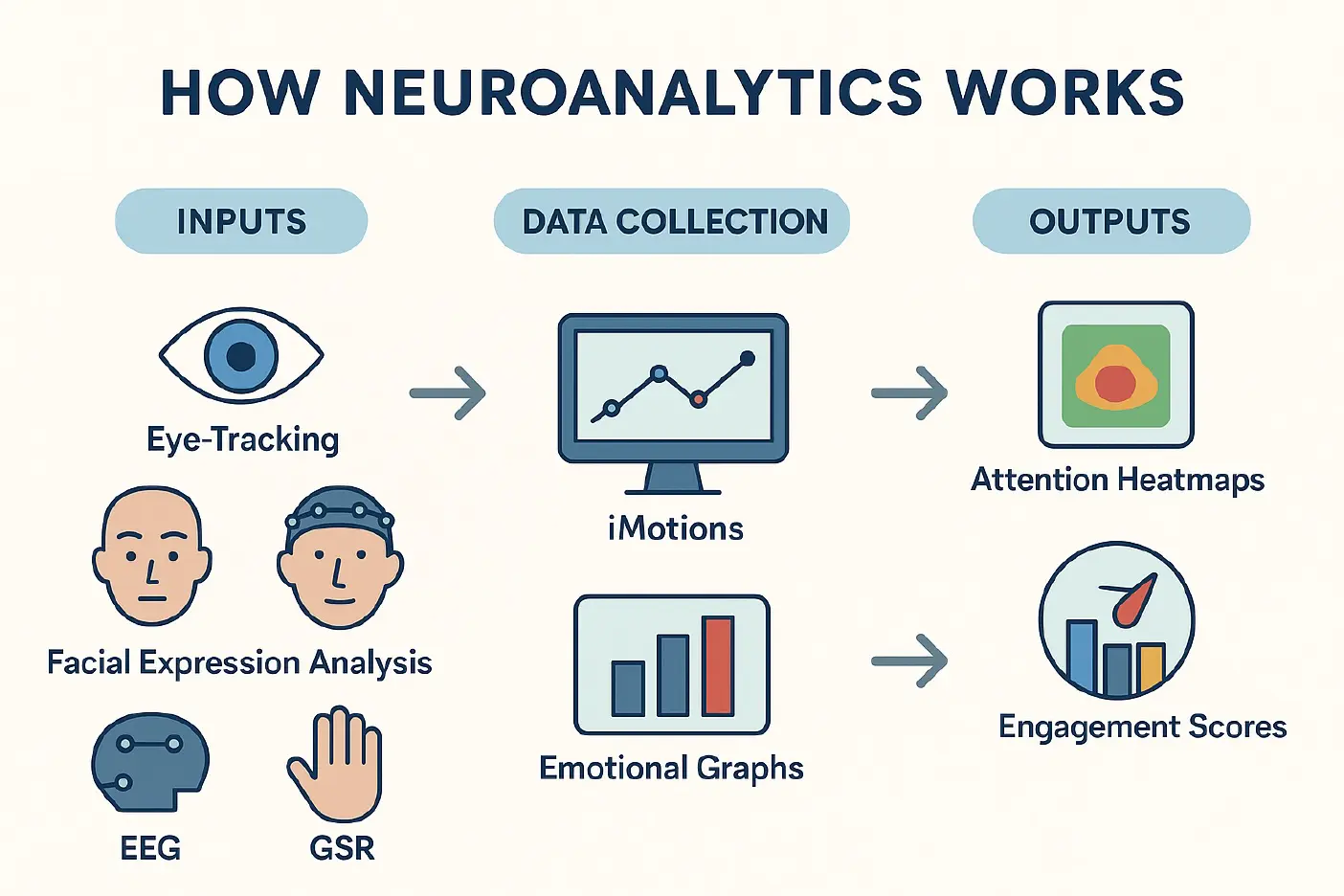
At its core, NeuroAnalytics is the analysis of biometric and neurological signals like eye movement, facial expressions, heart rate, and brain activity, to gain deeper insight into human attention, emotion, and decision-making.
It answers questions traditional methods often can’t:
- What part of the ad actually caught their eye?
- Did that message evoke trust or subtle anxiety?
- Were they paying attention, or just pretending to?
This isn't science fiction. Tools like eye-tracking, facial expression analysis, EEG, GSR, and voice analysis, often stitched together on platforms like iMotions, allow us to measure attention, emotion, cognitive load, and engagement in real-time.
Why Traditional Data Falls Short
Surveys and focus groups have long been staples of behavioral research and marketing. But they’re limited:
- People often say what sounds good, not what they actually feel.
- Memory is biased and unreliable.
- Social desirability can distort responses.
NeuroAnalytics bypasses these issues. It doesn’t rely on what people say, it watches what they do and how their bodies respond.
Why Now? The Age of Data Overload
With terabytes of behavioral data collected daily, we face a paradox: more data, but less clarity. Click-through rates, bounce times, and survey scores may hint at surface-level behavior, but they often miss the why underneath.
NeuroAnalytics bridges this gap. It adds depth to digital signals, allowing us to pair behavioral data with unconscious physiological reactions.
Imagine being able to:
- Test product packaging and predict purchase behavior before a launch.
- Optimize a website layout based on where users actually look.
- Design educational materials that adapt to cognitive load in real time.
- Evaluate political ads for emotional resonance and subconscious trust.
This is what NeuroAnalytics makes possible.
Real-Life Applications
Companies like Google, P&G, and Coca-Cola are already using biometric research to fine-tune their products and marketing. But NeuroAnalytics isn’t just for big brands. It’s transforming:
- Retail – Shelf layout optimization
- UX/UI Design – Testing visual hierarchy and usability
- Healthcare – Understanding patient emotional responses
- Education – Measuring attention and retention
- Public Policy – Evaluating message impact on behavioral change
And these are just the beginning.
The Future of Insight Is Biometric
As we move into an era where attention is scarce and emotional engagement is everything, relying solely on traditional data won’t cut it.
NeuroAnalytics allows us to understand the mind behind the data, helping brands, educators, researchers, and policymakers build more intuitive, human-centered experiences.
In future posts, we’ll take you deeper into the tools, the methods, and the real-world studies we’ve conducted using platforms like iMotions. We’ll also share the results of a recent neuro-driven study and what it taught us about attention, product placement, and behavior.
But for now, remember this:
Data tells you what happened. NeuroAnalytics tells you why it happened.
Sign Up for our Newsletter
Get the latest updates, insights and information from neurovantage - the North American authority on neuromarketing.
We never share your information. If you have any concerns, take a look at our Privacy Policy.