How We Read With Our Eyes: A Beginner’s Guide to Eye-Tracking
In today’s crowded digital and physical spaces, understanding where people look and why can make or break a design, message, or brand moment. Whether it's a product on a shelf, a logo on a screen, or a campaign ad on social media, human attention is the real currency.
This is where eye-tracking comes in. It’s one of the core tools in the NeuroAnalytics toolbox, and it helps decode what captures our attention, how long we linger, and what we miss entirely, often without realizing it.
Let’s break it down.
What Is Eye-Tracking?
Eye-tracking is a research method that measures where, when, and how long people look at different parts of a visual scene. Using sensors and webcams, it records the movement of the eyes as they navigate across images, videos, websites, packaging, or physical spaces.
It helps answer:
- What drew attention first?
- Which areas held attention the longest?
- What did the viewer skip?
Key Eye-Tracking Metrics Explained
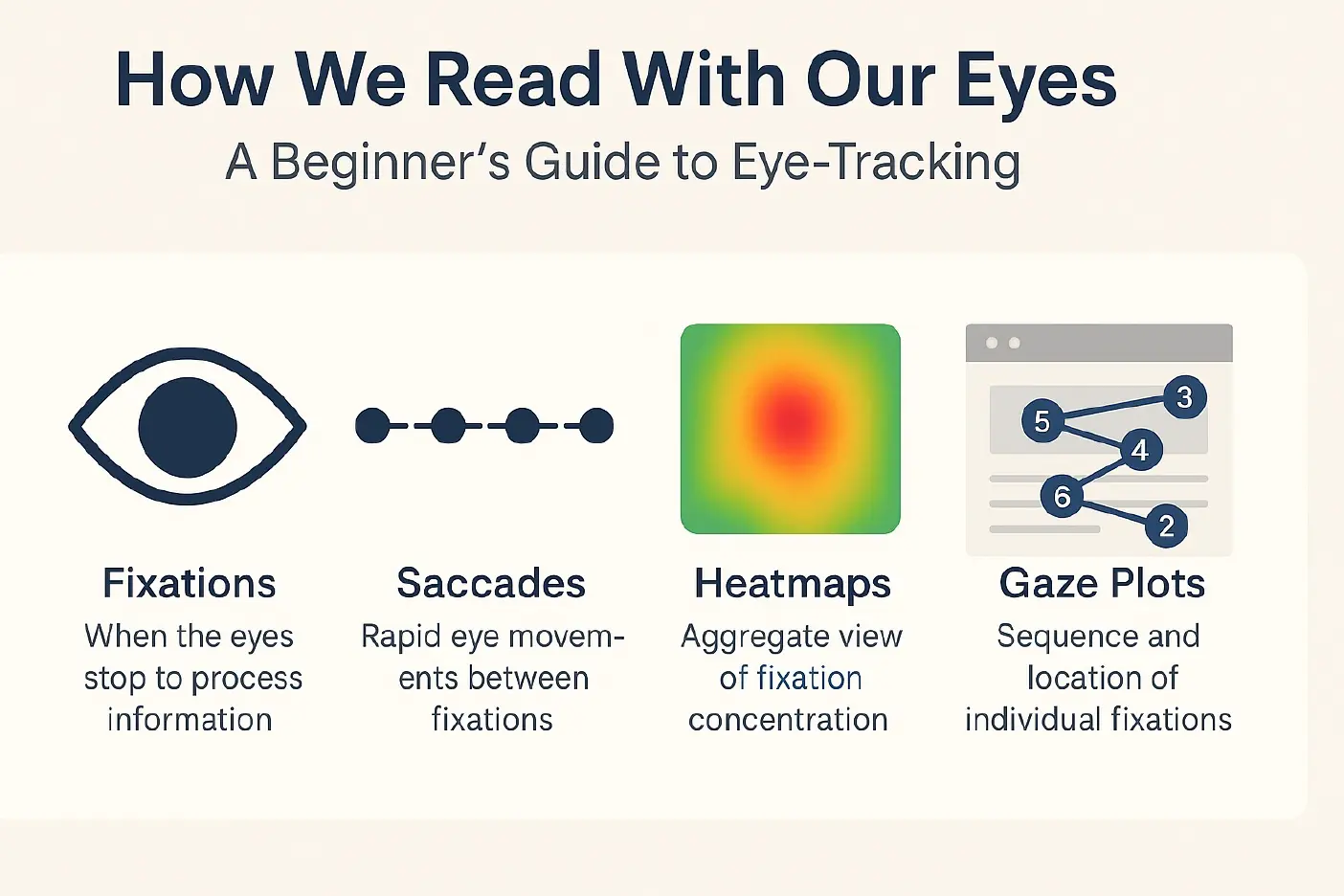
To understand eye-tracking, you need to get familiar with a few core metrics and visual outputs:
1. Fixations
These are moments when the eyes stop to process information. Longer or more frequent fixations on a spot usually indicate interest, importance, or difficulty.
2. Saccades
These are the rapid movements the eyes make between fixations. They're not about seeing, they’re about searching.
3. Heatmaps
Heatmaps show aggregated areas of visual attention. Warmer colors (like red or orange) indicate more attention; cooler colors show less. They’re excellent for spotting hotspots of viewer focus.
4. Gaze Plots
These show the sequence of eye movements across a screen, numbered in the order they occurred. Gaze plots help us understand navigation, flow, and visual hierarchy.
Why Eye-Tracking Matters
People don’t always say what they think or even know what’s influencing them. Eye-tracking reveals the unconscious decisions happening in split seconds.
Here are just a few real-world questions it can answer:
- Advertising: Which part of the ad draws attention first? Are logos getting noticed?
- Packaging: Does your brand pop off the shelf or get lost in the clutter?
- UX/UI: Are users noticing the CTA button, or skipping over it entirely?
- Retail: Are shoppers drawn to endcaps, or distracted by visual noise?
Eye-Tracking in Action: A Teaser
In upcoming posts, we’ll be sharing findings from two applied studies we recently conducted using iMotions:
- A Wendy’s × Takis co-branded ad analysis – where we discovered surprising insights about product placement and brand visibility.
- The Tropicana packaging redesign study – a case of missed attention that led to a $30M mistake.
These aren’t just academic exercises, they offer real, actionable marketing insight based on where people’s eyes actually went.
The Big Picture
Eye-tracking offers us a direct line to human attention, one of the most valuable and elusive commodities in business, education, healthcare, and beyond.
When used correctly, it helps us design not just more beautiful or clever visuals, but more effective ones, guided by how people naturally process what they see.
Up next: we’ll explore the gap between what people say and what their biometric responses show and why surveys alone often don’t tell the whole story.
Stay tuned.
Sign Up for our Newsletter
Get the latest updates, insights and information from neurovantage - the North American authority on neuromarketing.
We never share your information. If you have any concerns, take a look at our Privacy Policy.