Beyond Surveys: What People Can’t Tell You (But Their Bodies Will)
Ask someone if they like an ad, a logo, or a package design, and they’ll probably give you an answer. But here’s the truth:
People often don’t know what truly influenced them.
And even if they do, they may not say it.
That’s not because people are dishonest. It’s because our brains are wired to make decisions emotionally and subconsciously, far faster than our rational mind can catch up.
This is where traditional surveys and interviews fall short. And this is where biometrics and NeuroAnalytics shine.
The Limitations of Self-Reported Data
Surveys, focus groups, and interviews have been staples of research for decades. They’re cheap, scalable, and feel intuitive.
But they come with critical blind spots:
- Social Desirability Bias: People often say what sounds good, not what’s true.
- Memory Distortion: Our brains fill in gaps and rewrite details, often without our awareness.
- Low Emotional Resolution: Words like “I liked it” or “It was fine” don’t tell us much about the intensity or direction of a reaction.
- Cognitive Filtering: By the time someone explains their reaction, the raw emotional impulse has passed and been filtered.
What Biometric Data Reveals Instead
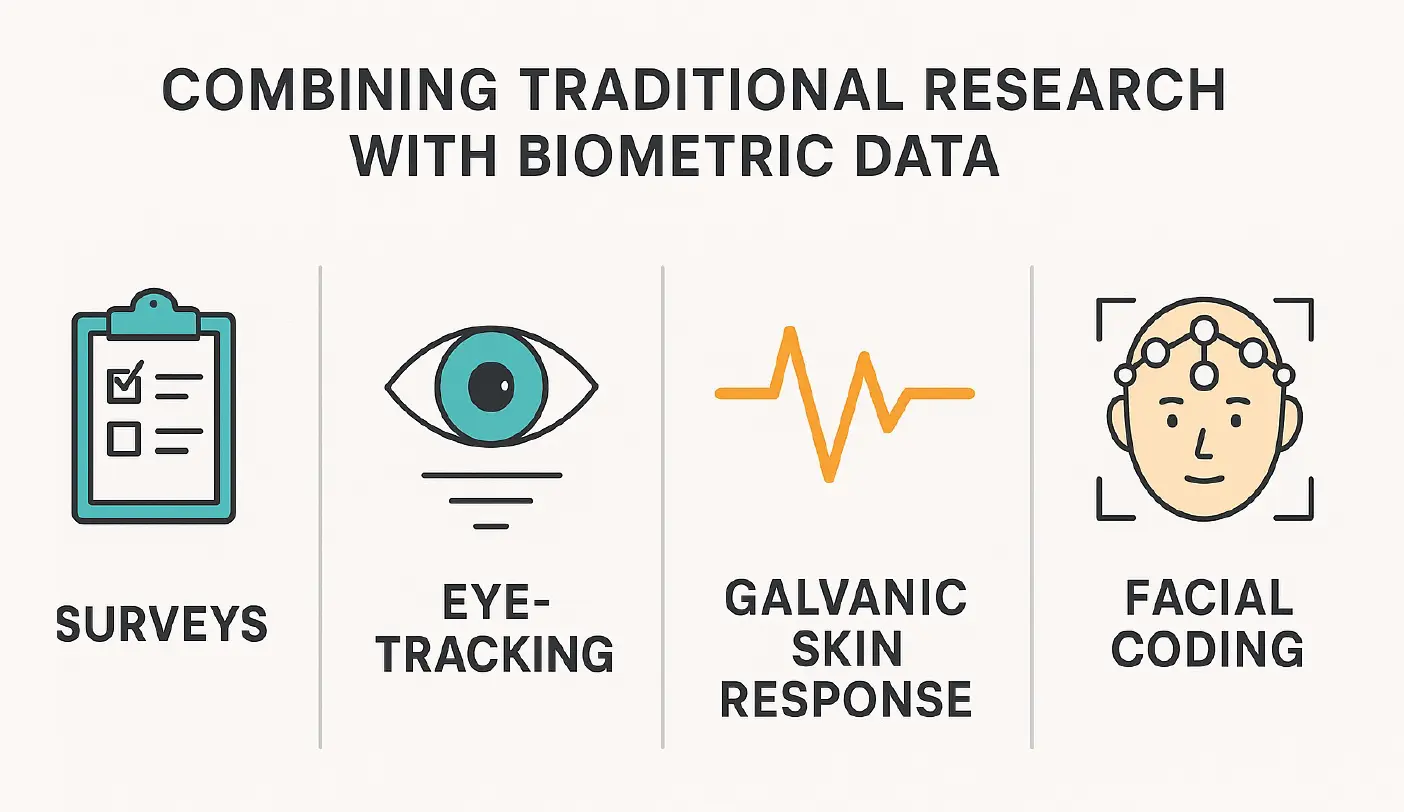
Biometric tools bypass conscious filters and give us access to the body’s real-time response. Using platforms like iMotions, we can collect data from:
- Facial Expression Analysis – Real-time emotional responses like joy, disgust, or confusion.
- Galvanic Skin Response (GSR) – Measures arousal; helpful for spotting spikes in emotional intensity.
- Voice Analysis – Detects tone, pitch, and sentiment embedded in how people speak.
- EEG – Tracks brainwave activity for cognitive load, engagement, or distraction.
All of this complements eye-tracking, which we discussed in the last blog.
These tools allow us to ask:
- Were they excited or bored?
- Did the ad confuse them or build trust?
- Was their attention automatic or forced?
Real-World Example: When Surveys Mislead
We recently tested a fast-food ad that received overwhelmingly positive survey feedback: “fun,” “bold,” “great flavor appeal.”
But when we looked at the eye-tracking and facial expression data, a different story emerged:
- The burger the hero of the ad was barely seen.
- Facial expressions showed micro-expressions of confusion around the co-branding elements.
- Brand logos were fixated on inconsistently.
This mismatch revealed a major disconnect between perceived recall and actual attention, something no survey could’ve picked up.
(More on this in an upcoming blog featuring the Wendy’s × Takis case study.)
The Future Is Multimodal
The most powerful insights come from blending traditional research with biometric data. Imagine being able to triangulate what someone:
- Says in a survey,
- Looks at via eye-tracking,
- Feels through facial coding or GSR,
- And experiences cognitively via EEG.
That’s not guesswork, that’s science-backed human understanding.
Takeaway
Words can lie. Looks can deceive. But the body? It tells the truth, whether we realize it or not.
If you want to truly understand customer behavior, it’s time to go beyond the clipboard and listen to what people don’t say.
In the next post, we’ll take you behind the scenes of a NeuroAnalytics study, how we designed it, what we tested, and how the data unfolded in real time.
Sign Up for our Newsletter
Get the latest updates, insights and information from neurovantage - the North American authority on neuromarketing.
We never share your information. If you have any concerns, take a look at our Privacy Policy.